Kavala: A Sensuous Blend
Multi-hilled, multicultural, multifaceted – refusing to fit into any mould, refusing to be categorised. Smelling of harbour, tobacco, and oriental incense. And beauty not confined to a specific area, but everywhere. Even where you least expect it. They called her the Monte Carlo of the East for her glamour, a blue city for her position…
Από Travelo Team
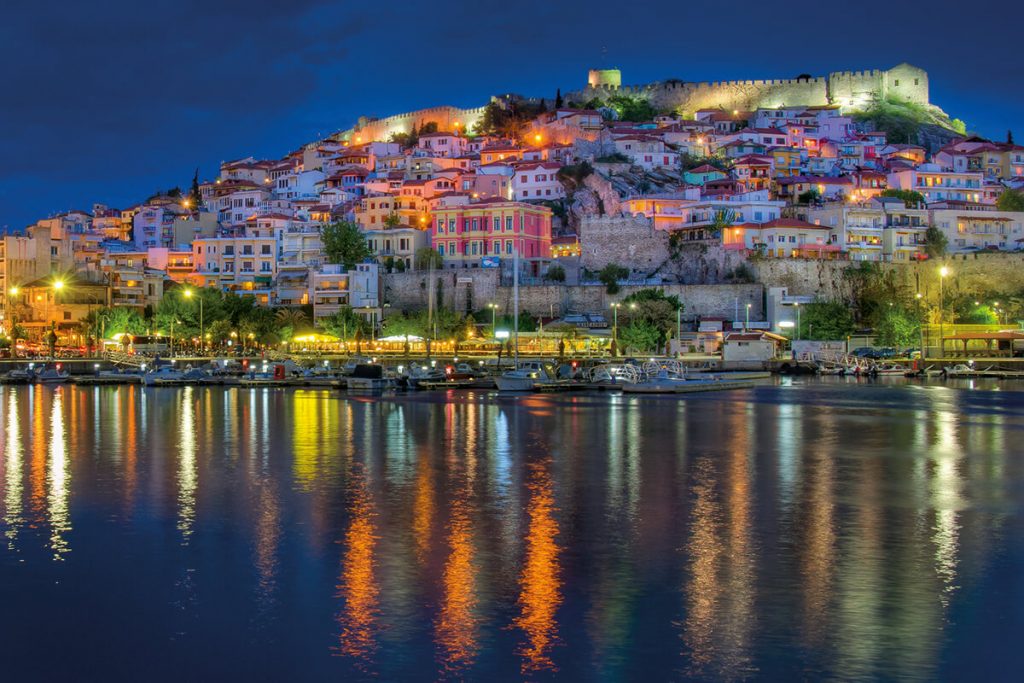
Multi-hilled, multicultural, multifaceted – refusing to fit into any mould, refusing to be categorised. Smelling of harbour, tobacco, and oriental incense. And beauty not confined to a specific area, but everywhere. Even where you least expect it.
They called her the Monte Carlo of the East for her glamour, a blue city for her position facing the North Aegean, the Mecca of Tobacco for her unparalleled tobacco history. They could also call her…
San Francisco for her successive hills, or a human melting pot for the disparate crowds she hosted and continues to host.
Her first inhabitants, Thasian colonists, christened her Neapolis, the Byzantines called her Christoupolis for Saint Paul’s passage – the first on European soil, the Turks named her Kavala because they used it as a stop with horses, or perhaps from the ancient Skavala…
Situated at a crucial crossroads from the very beginning of its existence, as an important port for Philippi and a station on the Egnatia Way, Kavala has been contested, conquered, razed, and rebuilt. Again and again. That’s 2,700 years of life…
Macedonians, Romans, Turks, Bulgarians, Jews, Pontic Greeks, Asia Minor refugees, Thracians, Sarakatsani, wealthy merchants, consuls.
The poor and the aristocracy, labourers and capital – everyone passed through here, for a short while or longer, destroying each other’s works, always taking something when leaving. But leaving behind much more…
If Kavala were a woman, she could be a sensuous Oriental lady or a photogenic Greek woman. An Asia Minor grandmother or a snobbish European.
A refugee girl, a working woman, a trade unionist, and at the same time a philanthropic aristocrat or a patron of the arts.
Within the salons of the intelligentsia and cosmopolitanism, she would carefully conceal her popular soul. And when she would stroll down to the harbour, she’d tuck her elegant hat into her pocket.
With the same ease, she would dance the foxtrot and the tsifteteli, eat caviar and pastourma, wear court shoes with a strap and torn stockings underneath.
When circumstances demanded, she would discreetly muffle her tobacco-induced cough behind a finely embroidered Asia Minor handkerchief, rub the smell of fish from her skin with oriental oils, plunge her nicotine-stained fingers from processing basmas into silk gloves, elegantly holding an industrial Virginia cigarette.
In any case, she would be a beautiful woman with the air of “the salon” and the vigour of “the port”. A woman capable of anything. She would charm everyone in an instant. With her curves, her culture, her beauty. This is what she does as a city, too.
[ Read also: Holidays in Thassos! ]
Glory be to Panagia!
A tongue of land jutting into the sea, laden with history and beauty. This is Panagia, the old town of Kavala. Low, old and new, red-tiled houses are arranged amphitheatrically, like in a school photograph, all looking out and all being seen.
Ancient Greeks and Byzantines watch visitors from a distance; the thread connecting them to the old town has been cut.
Only the Turks are constantly beside them, eloquent through their architectural remnants, and literally so, as Kavala is currently one of the most popular travel destinations for our neighbours!
All together they walk on the old cobblestones, instinctively ducking so as not to bump their heads on the projecting wooden structures, immersing their thoughts in the red, yellow, indigo colours that paint the houses with their mixed architecture.
Macedonian, Ottoman, Neoclassical, even new ones exchange elements, collapse, are restored, enjoying a healthy dialogue.
Imaret: Its history
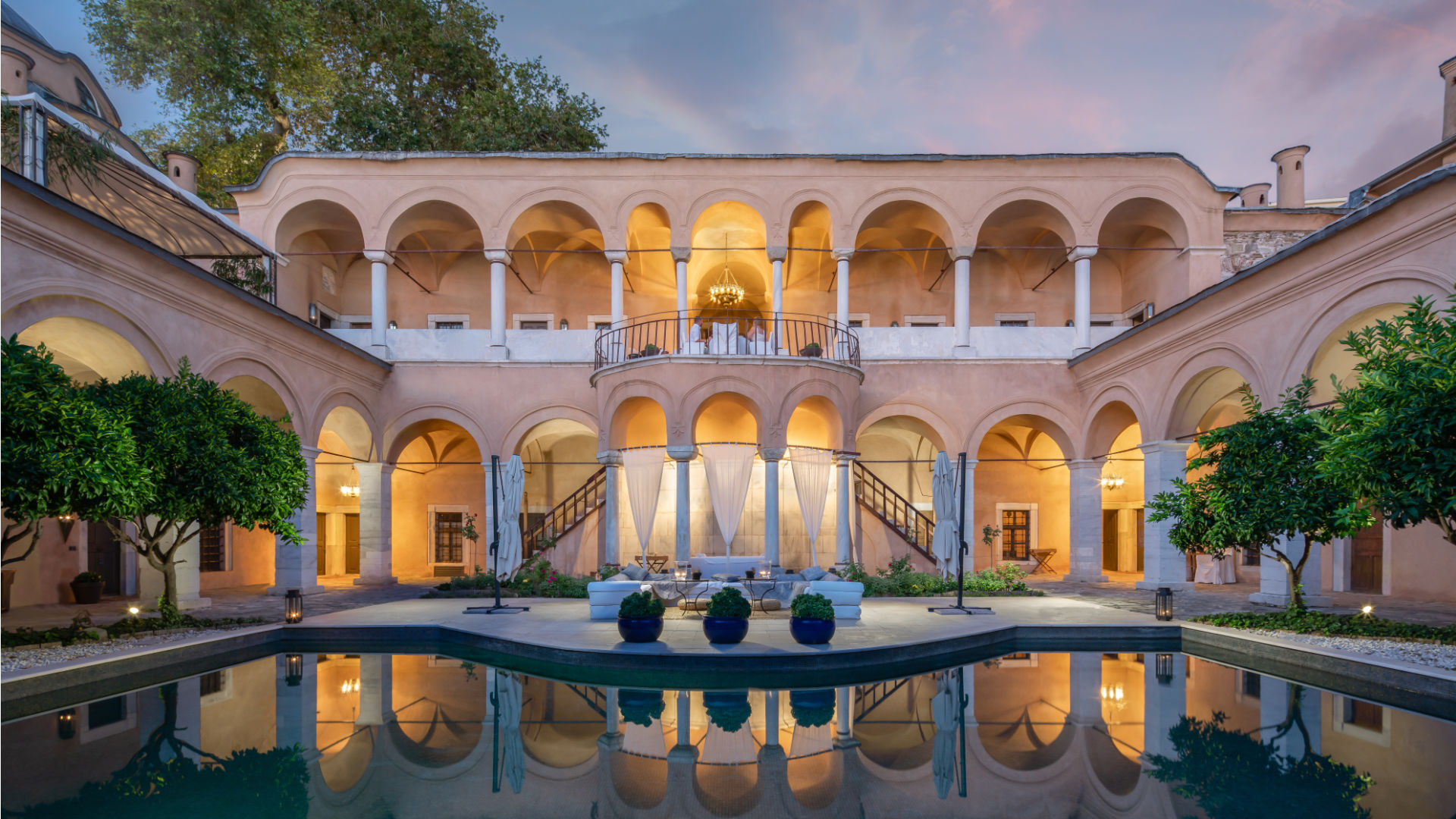
On Poulidou Street, steps… freeze. The Imaret, austere, silent, unsmiling, with its lead domes and chimneys, demands admiration. Behind its strict façade lies an entire history of Kavala, full of philanthropy, compassion, care, but also pain, self-interest, and strife.
It is the Islamic seminary donated by Mehmet Ali (Muhammad Ali), Wali of Egypt, to his birthplace in 1817.
The philanthropic and educational institution operated until 1909, then provided shelter and food to refugees and the destitute, until it was abandoned, partially collapsed, looted, and finally leased by the Misirian family, the only tobacco merchant family remaining in Kavala, and transformed by the passionate Anna Misirian into one of Greece’s most beautiful and luxurious hospitality venues (because you wouldn’t call this marvel a mere hotel!).
Thus, it entered the lives of locals with its café and restaurant, albeit with a controversial mode of operation and management, only to be violently exited recently. Its re-leasing (it belongs to the Egyptian state) by a company may seem like salvation for the monument, but it excludes non-residents, and therefore locals, from the common areas.
And it’s a shame… Not to live or, as a visitor, not to explore the atmospheric internal courtyards with their madrasas, cisterns, and cells – the rooms of the boarding students…
Disappointed, you seek solace a little further afield, in Mehmet Ali’s more… hospitable lodge, his parents’ house. It is considered one of the best examples of Ottoman architecture in Greece and once operated as a bar. Now it has taken its rightful place among museums, while its old stables function as a café.
A serene garden, oriental and atmospheric music, the hammam, the rooms of the selamlik (men’s quarters) and the haremlik (women’s quarters), adorned with carved ceilings, hookahs, low tables, glass panels, chandeliers in atmospheric chiaroscuro, cushions and silk fabrics slightly dishevelled, as if the sensuous odalisque had just been there moments ago.
But where did she go? All right, you’ll gladly wait for her until the evening, when everything here becomes even more mysterious anyway. And without fear. The bronze Mehmet Ali outside, in the square, puts his sword in its sheath, a sign that he’s returning home and isn’t in the mood for a fight…
From the Sahnisia to the Castle
Opposite the impressive… “duology”, the most striking remnants of Ottoman rule, the Church of the Dormition, Panagia, proudly stands tall. It christened the old town and was once the only Greek element of “Turkish” Kavala (to be precise, its predecessor which was demolished in the 1950s) around which the few Christians of the city had squeezed in as best they could.
Only a few metres further, the peninsula plunges into the sea. The old lighthouse casts its beam on the rocks where locals swim (those who snub the city’s famous beaches!) and directly above it, another… lighthouse, this time of knowledge, enjoys the incredible view: the 7th Primary School! It’s not the only privileged one… In Kavala, it seems, schools, both inside and outside the walls, have beautiful “homes”!
The steps continue uphill along the narrow streets of Panagia, cars scrape the corners on turns, the scenes in the courtyards, perhaps even the people, are of an old… kind. The houses get even lower as the altitude increases, appearing sometimes well-maintained and other times in ruins, revealing the ground-floor stonework and the reeds on the upper floor as the plaster abandons them.
[ Read also: 10 places in Greece worth visiting before they become too expensive ]
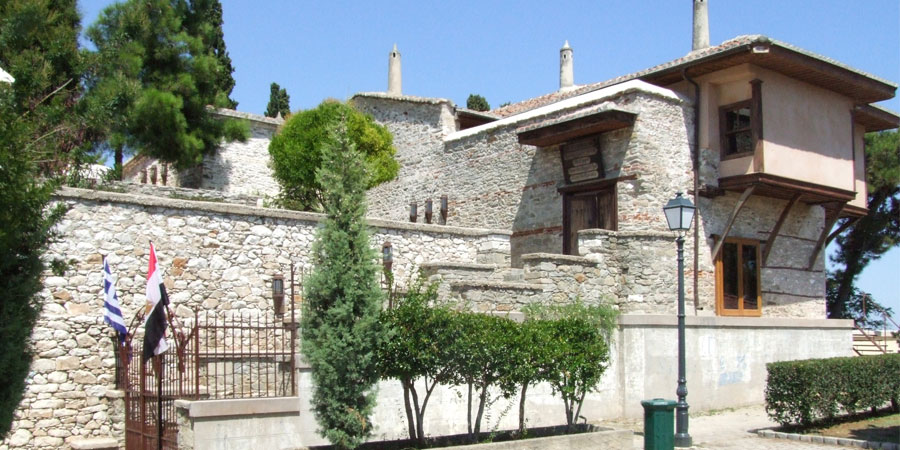
Mehmet Ali Street: the old "Music School", named after the municipal band's rehearsals, is officially called the Halil Bey complex (including a mosque and madrasa), but no one calls it that. On its site was the Byzantine church of Agia Paraskevi, now visible under the glass floor in a rare, spectacular blend that demonstrates continuity and mesmerises both Christians and Muslims.
A little later, the steps finally reach the top of the strategic hill that was always a castle – what else? From ancient Neapolis, to Byzantine Christoupolis, and Ottoman Kavala, this was the city's administrative centre. The reason becomes clear immediately: the view in all directions, from the great tower, is absolute.
The modern city spreads across its hills like a silent wave. So too does its beauty. From up here, it begins and spreads beyond the walls. And so did the people, who exceeded the limits of Panagia from 1864 onwards. With the Sultan's permission, of course.
Smooth Transition
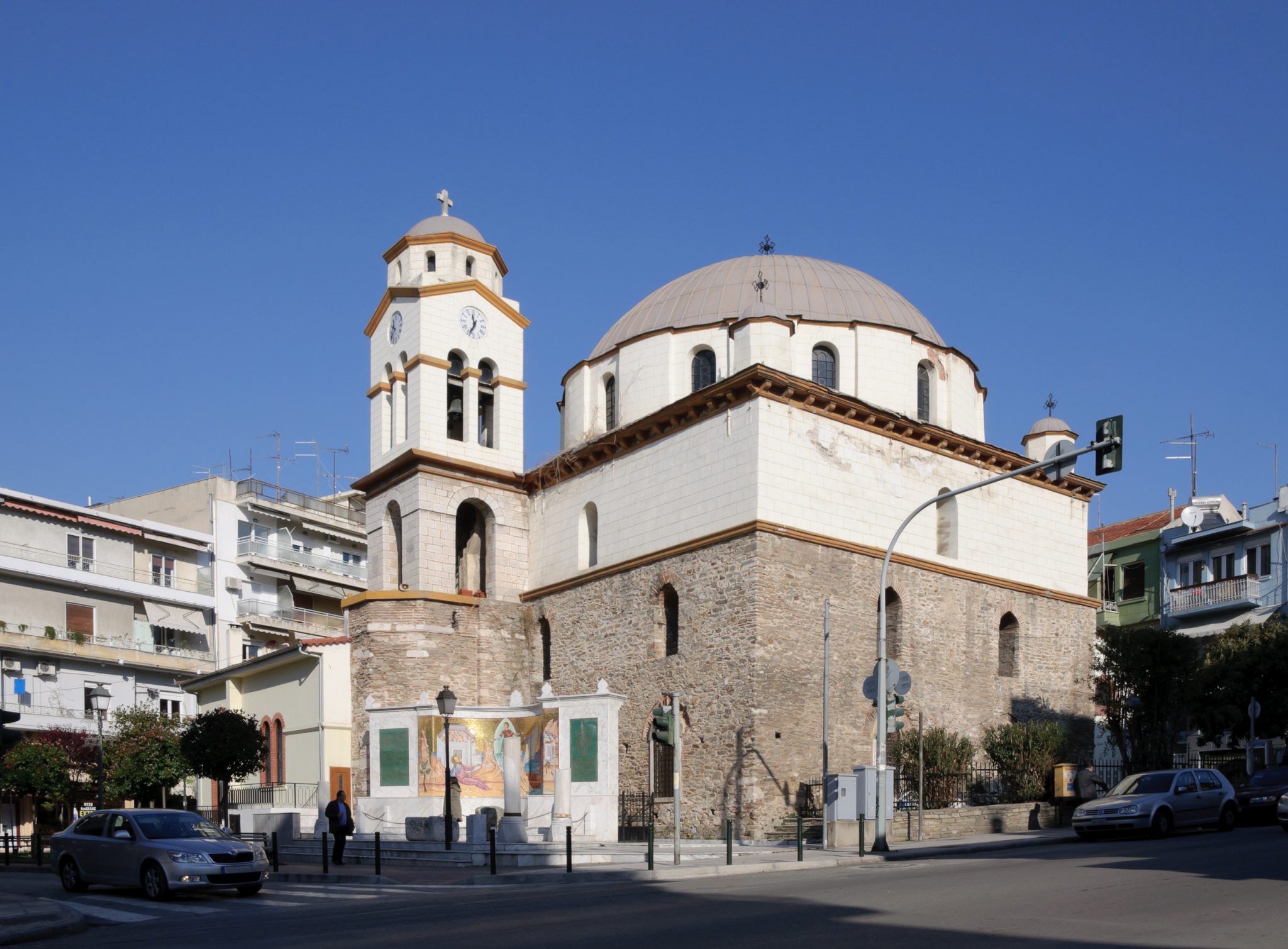
When your foot stops treading cobblestones and hits asphalt, it’s a sign that the new city begins, or… almost. The area of Agios Nikolaos, on the slopes of the hill, is the oldest, the Muslim quarter of Ibrahim Pasha (a Greek Janissary from Parga, the famous “Pargalis”, who also appeared in the Turkish series “Suleiman the Magnificent”).
An undeniable landmark is the… church of Agios Nikolaos, a former mosque (the largest in the city) and, perhaps, an even older temple and coastal area said to have welcomed Apostle Paul to Europe – in whose honour the relevant “pulpit” has been erected.
The old market, faithful to its Ottoman design, is a small cobbled labyrinth where bars and restaurants have taken on the task of keeping it bustling!
And this is how you finally reach the famous Kamares, Kavala’s emblem. Like an umbilical cord connecting the peninsula with… the rest of Macedonia, the last section of a magnificent 6.5 km aqueduct reconstructed during the reign of Suleiman the Magnificent, when the city began to rebuild, it is equally magnificent.
It marks the starting point of a lovely hiking trail to the Soumpasi spring and is a symbol for locals who say “the living dead pass through here”, based on an old tradition that viewed the arches as a border between the upper and lower worlds. You too pass with the cars under the transcendental arches, almost moved by the few small houses clinging to it, nestling affectionately between the arches like children at their father’s feet, and descend towards the shipyard.
The “Vlachakia”, namely Giannis and Iordanis Vlachos, and Panagiotis Karababas, are responsible for repairing and, more rarely, building boats, fishing vessels, and trawlers for Kavala’s renowned fishing fleet. And since such sights are rare in Greece now, extend your stay and sit at the “invisible” small coffee shop – a favourite haunt of Kavala locals – which has been operating since 1922. Mezedes, atmosphere, and rebetika create moments you also rarely find in Greece!
Memories and Aromas
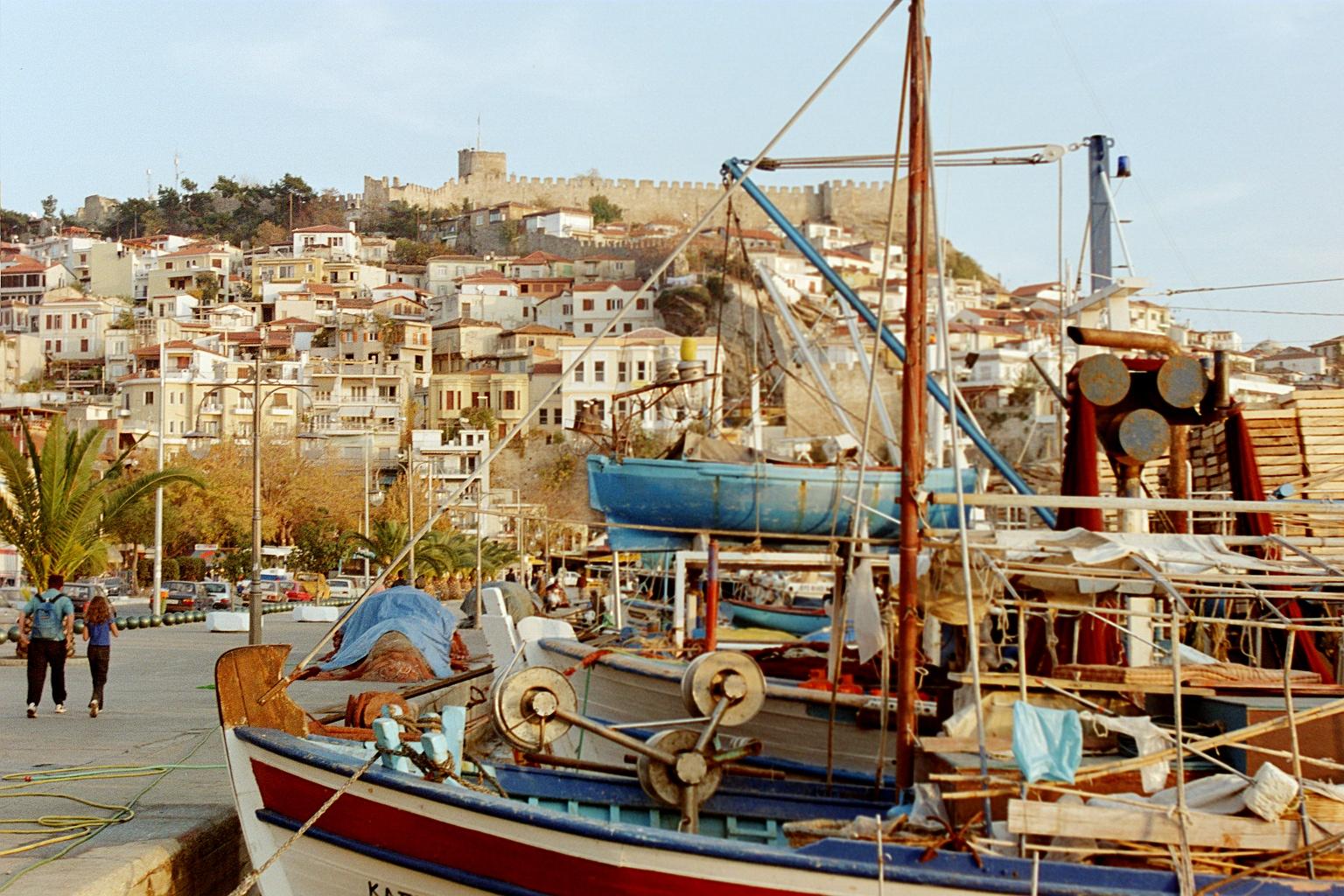
Boatmen and fishermen mend their nets on the other side of Panagia, in Kavala’s expanding passenger port. With your gaze always drawn to Panagia and the castle, you greet fishing boats, yachts, sailing boats, smaller vessels, and recently cruise ships, and if you wish, traverse the entire coastal front of the city.
Enjoying, that is, the stroll “from the Park to Myrovolos” (or vice versa in this case) which became famous through the lyrics of Argyris Bakirtzis, the singer of Himarini Kolimvites, where “park” refers to Faliro Park and “Myrovolos” is the legendary patisserie “Myrovolos Anixis”, absolutely connected with the “discerning” youth of the 1970s.
North of the coastal promenade stretches the new city, which you might not expect, but it’s far from uninteresting. Quite the opposite. It’s beautiful and well-kept. From Eleftherias Square to the districts of Agios Ioannis and Agios Pavlos, redevelopment has done its job well, yet you sense aromas from everywhere.
The scent of home-cooked food wafts from the neighbourhoods hidden behind the massive apartment blocks, feminine perfume from the commercial street of Omonoias, glamour from the archaeological museum on Erythrou Stavrou with its distinctive exhibits.
It smells of youth from Megalou Alexandrou Square and incense wafting from the churches of the patron saint Agios Pavlos and Agios Ioannis Prodromos, the city’s oldest (1860). It smells of Europe from the Catholic Lazarist Monastery, which hosted the children of European merchants as a college, and fresh fish carried by the garbis wind from the fish market, one of the largest in the Mediterranean. Occasionally, it smells of pine from the peri-urban forest, but here Kavala primarily smells of… tobacco.
In the narrow streets of the centre is written, perhaps, Kavala’s most important story. That of the precious Basma, the product that made Kavala rich, developing it into an important commercial and cultural centre and, at the same time, the largest tobacco processing centre in the Balkans.
The aromatic Basma, whose processing and trade flourished dramatically in the late 19th century and soared after liberation, brought capital and population from all over Europe and Greece to Kavala. It provided wages for tens of thousands of refugees, whether in tobacco warehouses or tobacco fields, becoming the country’s largest source of foreign exchange through its exports, and led the city to boast over 100 tobacco warehouses and 15,000 workers (half of Greece’s total).
It was this that gave birth to trade unionism. That made the stevedores, the 'dexides' (selectors), the 'pastaltzides' (packers) who worked endless hours in the damp “salons”, transporting, selecting, bundling tobacco into packages – works of art – to rise up and demand their rights. To organise the first tobacco workers’ strike under the Ottoman Empire in 1879, and to establish unions from the early 20th century.
[ Read also: Useful tips for car rental during your holidays! ]
With an Addictive Aura
The cycle opened, then closed. With the crash of 1929, the countdown began. This was followed by the introduction of the 'tonga', a quick sorting method that eliminated processing, and with it, the “takeover” of these positions by much “cheaper” women.
Strikes and occupations cost everyone. New technologies emerged, as did “Virginia” tobacco, until the curtain finally fell in the 1950s with the liberalisation of the profession… You walk for hours searching for history in the buildings.
In Kapnergatis Square, you notice the Municipal Tobacco Warehouse housing the Nautical Museum, the neighbouring commercial centre enjoying its new use, the controversial monument to the tobacco worker… On Cyprus Street, you observe the Wix Mansion, the tower-like town hall, once the home of the Hungarian tobacco merchant Pierre Herzog, the adjacent Grand Club which hosted numerous social events in its salons, the Tokkou Mansion, the Municipal Conservatory – once the home of the Grigoriadis tobacco merchants…
You wander through the surrounding streets, impressed by their sheer number, even knowing that not even half remain, that every apartment building you see was once a tobacco warehouse. But the answers will only come from the lips of the people and from the photographs and valuable archives of the Tobacco Museum. From Mr. Giannis Vizikas, who will tell you about the ideal climate and soil, about the tobacco merchants, the trade unionists, the first communist (and refugee) mayor of Greece elected in Kavala, about everything…
Goodnight from Kavala!
From people born and raised amidst tobacco, like Mr. Haris Iordanidis, who is a magnificent museum in himself… Who remembers the working hours from all the positions he held until he became an expert, who knows better than anyone all the stages, all the history, and all the stories. And all the tobacco warehouses and buildings of the city, of course, so he rightly laments their present and uncertain future.
“Mr. Haris, do you smoke?” you ask, certain of the answer. “I quit as soon as I retired,” he replies. And Kavala quit, cold turkey. It cost her, but you don’t fear her. You see her around you, gleaming coquettishly, …addiction-free and confident that with a smile she will win you over too. Let’s see how you’ll kick the habit now. The habit of loving her!
Useful information for your trip to Kavala
* Search for cheap hotels throughout the Kavala region HERE
* Find cheap flights to and from Kavala airport from Travelo.gr
* View the official website of the Port of Kavala

Η συντακτική ομάδα
Travelo Team
Συντακτική ομάδα του Travelo.gr
Πολυταξιδεμένη συντακτική ομάδα με πάνω από 15 χρόνια στον ταξιδιωτικό δημοσιογραφικό χώρο και περισσότερους από 45 προορισμούς σε Ελλάδα και Ευρώπη. Έχουμε διανυκτερεύσει σε εκατοντάδες καταλύματα — από μικρά οικογενειακά ξενοδοχεία και παραδοσιακούς ξενώνες μέχρι resorts 5 αστέρων — και δοκιμάζουμε προσωπικά περιοχές, μεταφορές και υπηρεσίες πριν προτείνει κάτι.
- 45+ προορισμοί επί τόπου
- 500+ καταλύματα σε αξιολόγηση
- 15 χρόνια ταξιδιωτικής αρθρογραφίας
Πώς δουλεύουμε: κάθε οδηγός βασίζεται σε επιτόπια εμπειρία, διασταύρωση αξιολογήσεων επισκεπτών και έλεγχο διαθεσιμότητας/τοποθεσίας κάθε καταλύματος. Ορισμένοι σύνδεσμοι είναι συνεργατικοί (affiliate) — αν κάνετε κράτηση μέσω αυτών, στηρίζετε το Travelo.gr χωρίς καμία επιπλέον χρέωση για εσάς, και δεν επηρεάζουν τις προτάσεις μας. Τελευταία ενημέρωση οδηγού: 22 Σεπτεμβρίου 2026.