Discover the Bridges of Epirus!
Beautiful human creations that withstand the test of time and carry legends and traditions. The need for communication amongst themselves and with the rest of the world forced the people of Epirus, from very early on, to bridge ravines, rivers, gorges, and waterways that blocked their path or prevented them from crossing. Single-arch, double-arch, triple-arch, or even larger bridges were built with…
Από Travelo Team
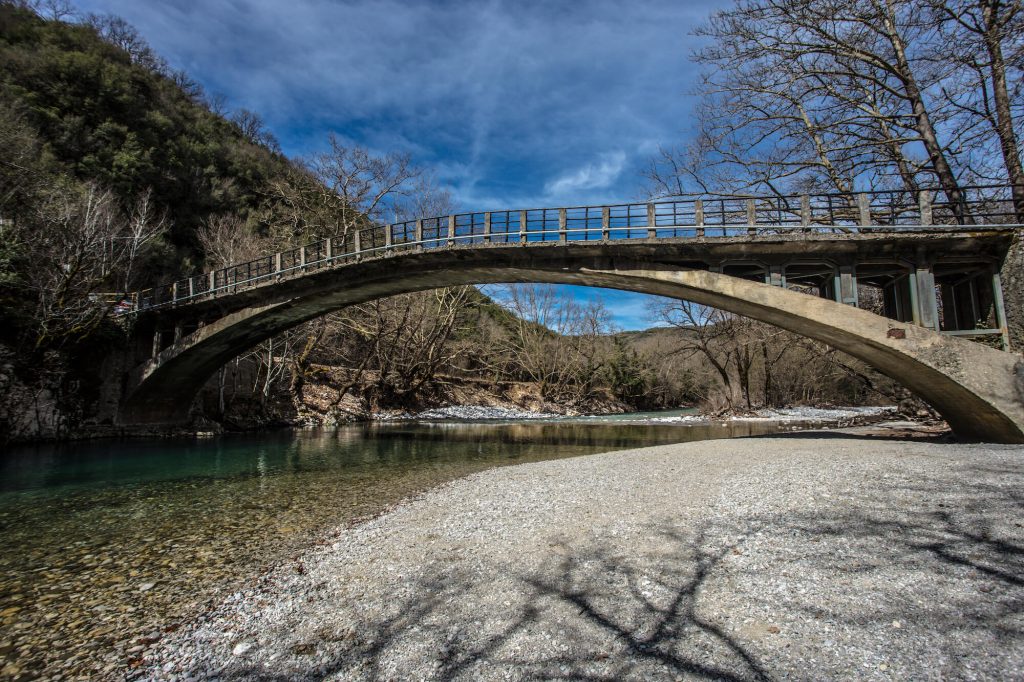
Beautiful human creations that withstand the test of time and carry legends and traditions
The need for communication amongst themselves and with the rest of the world forced the people of Epirus, from very early on, to bridge ravines, rivers, gorges, and waterways that blocked their path or prevented them from crossing.
Single-arch, double-arch, triple-arch, or even larger bridges were masterfully erected by the skilled Epirote stone masons. Sometimes on extensions of rocks and mountains, sometimes on steep slopes and difficult paths, and other times on riverbanks, these bridges enshrined legends and traditions.
Forced to travel in search of better fortune away from their rugged and barren homeland, which they deeply loved, the Epirotes, upon returning, wanted to create something that would endure; on the one hand, to serve the needs of the local inhabitants, and on the other, for their name to be remembered in history.
However, sometimes the decision to build a large bridge required the entire village, and if there was no help from a benefactor or donor, be they a Greek or Turkish official or even an abbot from a monastery, then everyone was obliged to contribute. Over time, the bridge would acquire its name for various reasons. If it was a donation, however, it would take the name of the benefactor-donor as a token of gratitude.
Many bridges have survived and still bear the name of the benefactor who built them, as do most of the master stone carvers who, with unique skill, built bridges that have endured the passage of time and the fury of the elements, demonstrating their worth. Beyond their utility, they have remained as unique ornaments of the Epirote landscape.
Large or small masterpieces stand out for the perfection of their construction and the elegance of their appearance, blended with wild rocks or dense vegetation over rivers, sometimes rushing and foamy, and other times calm and dry. Each has its own story and legend, such as that of Arta, which, according to our folk tradition, would only stand if the master builder sacrificed his wife.
Stone masons, by 'locking' the keystone at the apex, solidified the bridge's arch and became renowned for their abilities. Indeed, many of them, with their workgroups, travelled abroad in later years, building bridges and arches that still stand proudly today.
The master builder led the team, concluding agreements for projects, drawing up construction plans, and giving instructions to everyone: quarrymen (for extracting and selecting stones), mortar mixers, marble carvers, masons, carpenters and woodcarvers, painters, and labourers, who were usually young children helping and learning the trade.
Stone bridges exist throughout Greece, but those in Epirus are the most famous, such as the one in Arta and Plaka. However, the most numerous, oldest, and most interesting examples are found in Zagorochoria.
The primary material for building a bridge was stone, carefully selected one by one, shaped as needed, and set aside until the wooden framework was ready for construction to begin simultaneously from both sides, culminating in the 'meeting' to 'lock' the arch.
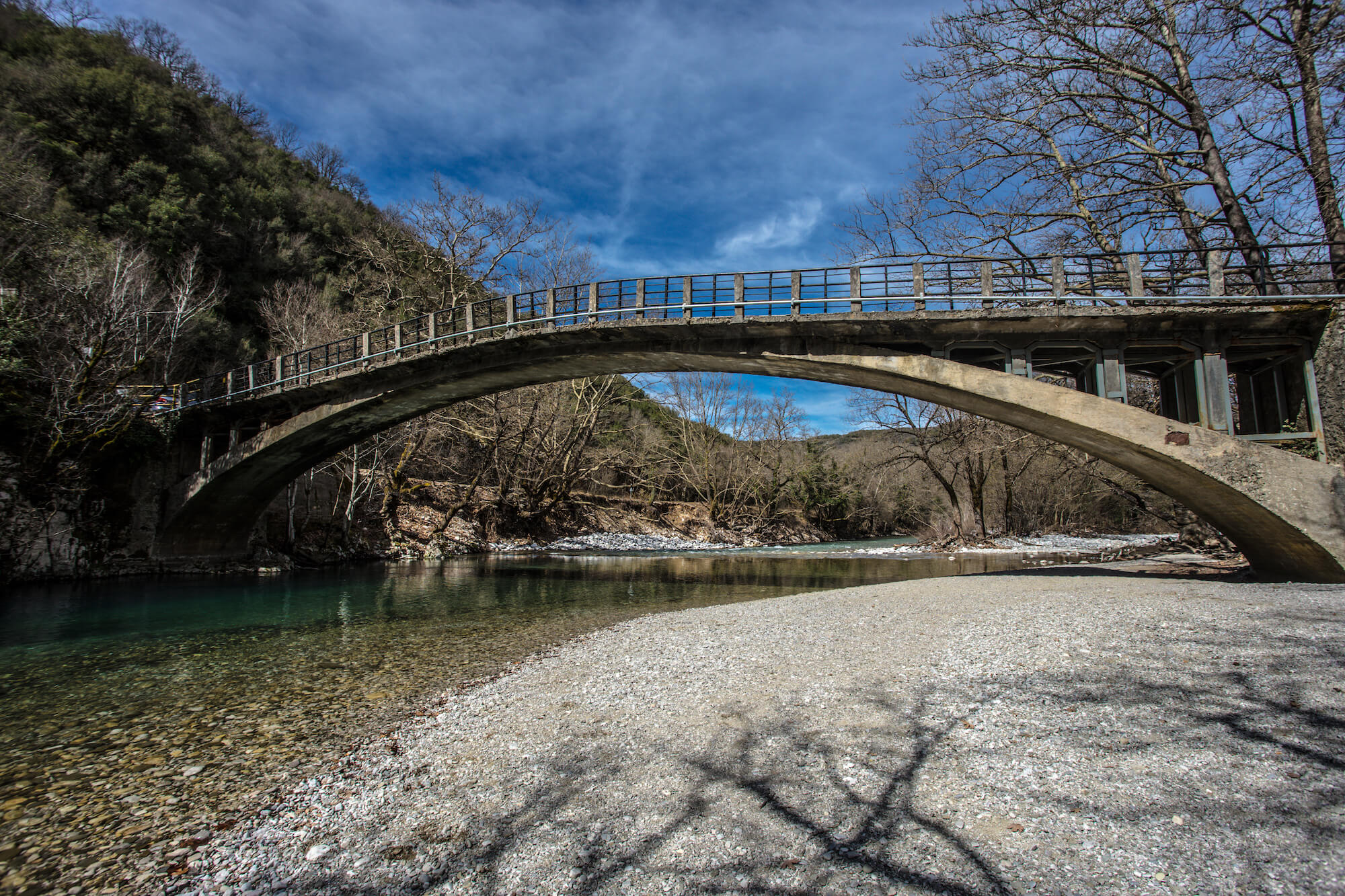
It was the stone that balanced opposing forces and provided stability. This was mainly done for single-arch bridges, depending on their span, some larger than the Plaka bridge, and also for the others with multiple arches.
Any foundations placed in the riverbed were conical towards the water flow so that the water would glide past and not press against the base. The width of the bridge was not great and usually sufficient for a loaded animal to pass over it, i.e., about 2 metres, though there were narrower and wider ones. They were paved with cobblestones, like village roads, but the 'ouvies' – the vertical stones that protruded to prevent animals from slipping – were more densely placed.
Additionally, the sides of the bridge had low walls or thin upright stones, 60-70 cm high, serving as protective railings. While on both banks of the bridge, low walls were typically built to aid in loading and unloading or mounting. This was because many people were afraid to cross the bridge on horseback.
Hundreds of bridges were built in Epirus centuries ago, but few of them survive today in good condition. This is because, like any man-made structure, they required maintenance to withstand the passage of time.
Thus, once paved roads began to be built and the need for the bridges continuously diminished, there was no longer adequate interest in their maintenance. Consequently, many of them began to collapse, and today only a few stones remain to attest to their former presence, or they are preserved in written records from those eras.
In recent years, however, these bridges have been designated as protected monuments of folk architecture and significant examples of our cultural heritage. This led to renewed interest and funding for their preservation by specialised craftsmen, guided by architects and archaeologists. In this way, these spectacular human creations – stone bridges, magnificent and resilient – continue to stand, carrying with them legends and traditions that stretch back into the mists of time.
They stand proudly where they are, and while they may no longer serve practical needs, they certainly attract the interest of all who visit the area, who marvel at their exceptional artistry, beauty, and history.
Each has a unique story: when, how, and by whom it was built, what it served, and what happened over time, allowing the accompanying tale to become a legend.
Plakida Bridge
The Plakida Bridge, also known as Kalogeriko Bridge, is near Kipoi in Zagori. Initially a wooden structure, in 1814, Monk Seraphim from the Holy Monastery of Vitsa rebuilt it in stone, costing 20,000 groschen, hence its name Kalogeriko (Monk's Bridge). In 1865, it was repaired by Alexis Plakidas and his brother, from whom it subsequently took its name.
Kokkorou Bridge
Among the most significant bridges in Zagori is the single-arch Noutsou or Kokkorou Bridge, built in 1750. Its benefactor was the lord Noutsos Kontodimos from the neighbouring village of Kapesovo. It was at this narrow point of the river, where the waters gained momentum, that Grigorios Kokkoris had built his watermill, giving the bridge its second name.
Vovousa Bridge
In the main village of Eastern Zagori, Vovousa, which is built next to the Aoos River at an altitude of 1000 metres, nestled in the Pindus mountains, the only connection to the other villages of Zagori was via the large single-arch bridge built in 1748 by Alexis Misios. The bridge is still in use today, connecting the two districts of the village, located on the right and left banks of the Aoos River.
Arta Bridge
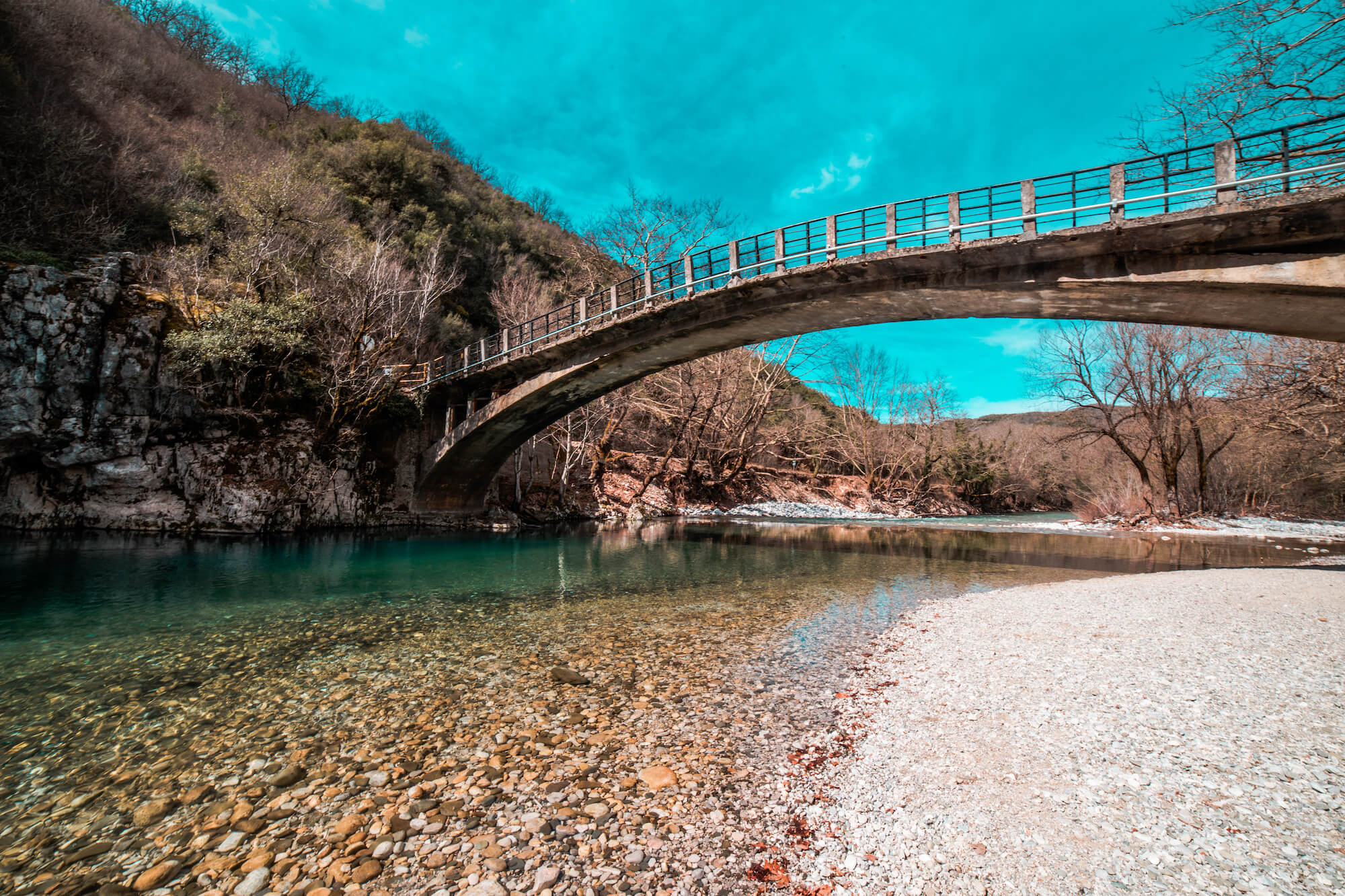
The most famous is the Bridge of Arta, owing its fame to the legend of the master builder's wife who was sacrificed for its stability. It is believed to have been built between 1602 and 1606, and its current total length is 145 metres, with a width of 3.75 metres.
Konitsa Bridge
At the narrowest point of the Aoos River, near Konitsa, in 1871, Ziogas Frondzos, a master builder from the neighbouring village of Pyrsoyianni, constructed perhaps the largest single-arch bridge in Greece, which cost 120,000 groschen.
Plaka Bridge
The largest single-arch bridge, first built in 1860, collapsed and was rebuilt in 1863 at a cost of 187,000 groschen. As the Arachthos River formed a natural border between Greece and Turkey from 1881, the bridge was essentially not used until 1913.
Perdika Bridge
The ancient Somati Bridge in Perdika, Thesprotia's Recreation Park.
Misiou Bridge
The Misiou Bridge is located in the Vikos Gorge, connecting its opposite banks. It was built in 1748 as a donation by the benefactor whose name it bears.
Kamber Aga Bridge
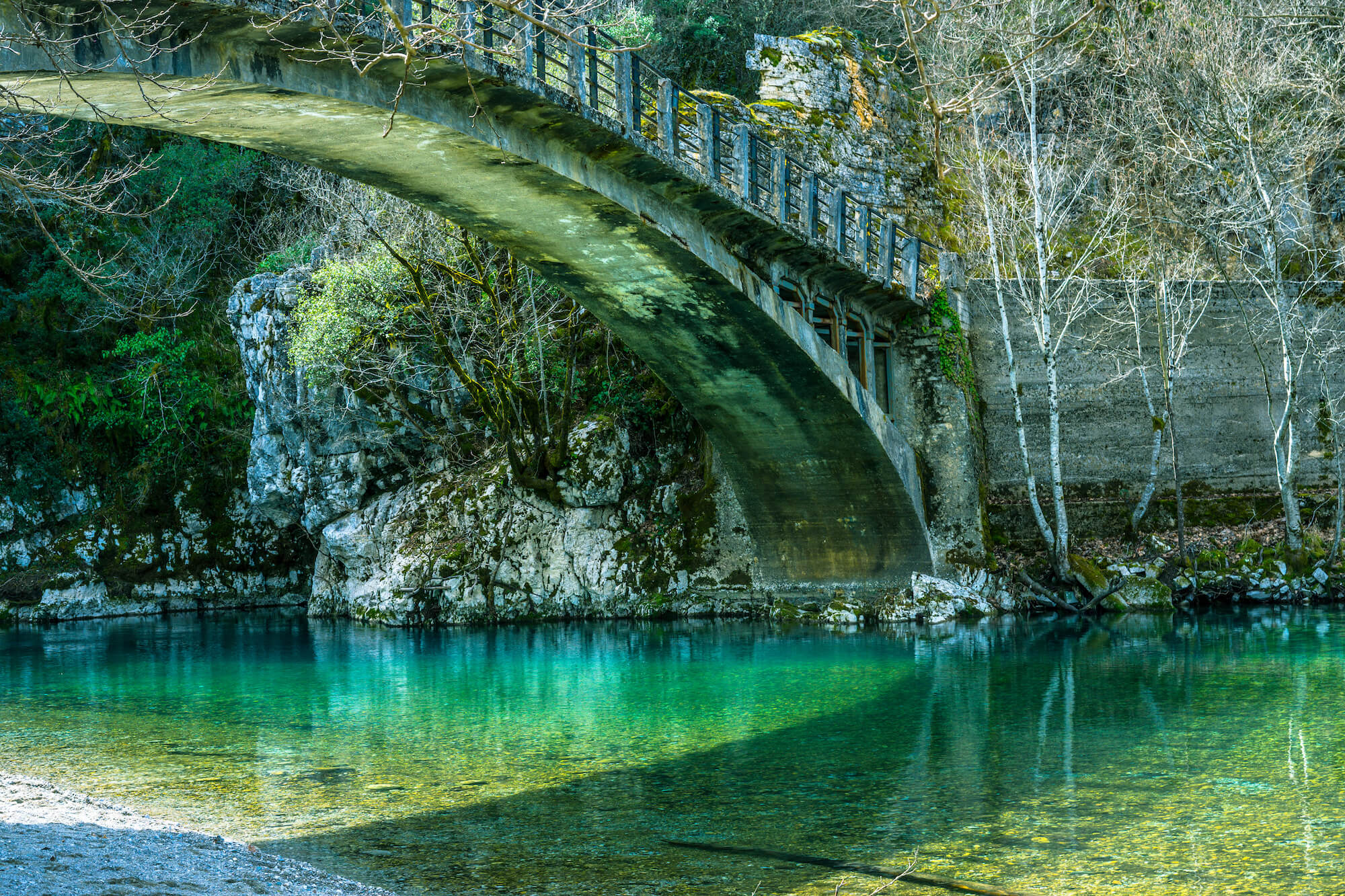
The single-arch bridge with a pointed apex, known as Kamber Aga Bridge, is located near the sources of the Arachthos River, on the provincial mountain road connecting Ioannina with Eastern Zagori. It spans the Zagoritikos River, a tributary of the Arachthos. The date of its construction is unknown, but it is known to have been funded by Kamber Aga (a Turkish official from the city of Ioannina, from whom it takes its name).
Kalota Bridge
The Kalota Bridge is located near the Holy Monastery of Visokou and spans the Zagoritikos River. It was built with funds from the inhabitants of Kalouta, near Stefos Goulas's Mill, which stood nearby. The date of its construction is unknown.
Petsioni – Fraggadon Bridge
One of the oldest and most imposing bridges in Zagori is the triple-arch bridge of Fraggadon, built near the Mill of Th. Petsionis, from whom it also takes its name.
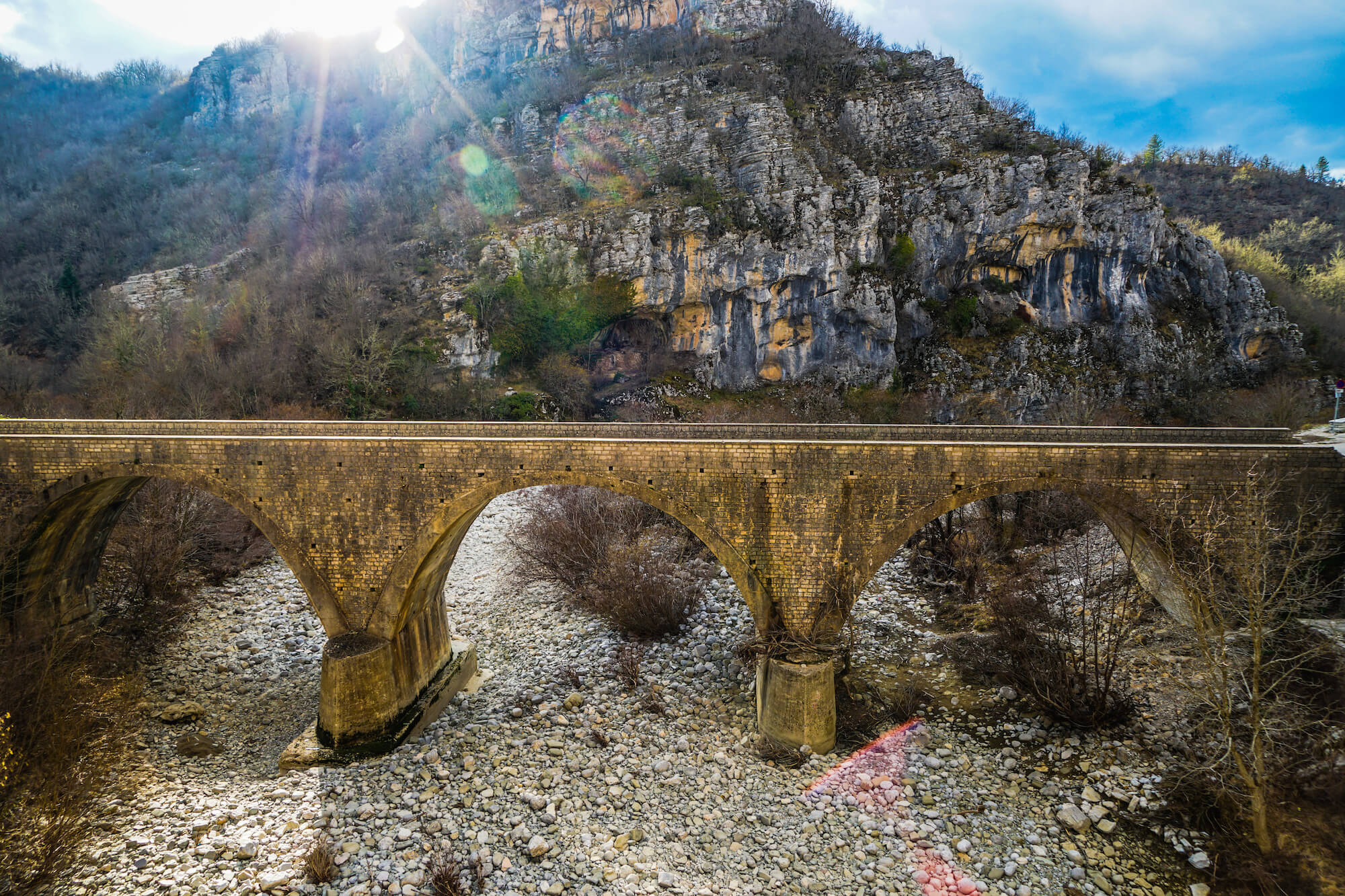
Anilio Bridge
The traditional Stergiou Bridge in Anilio, which is in its present condition after maintenance due to damage it had suffered.
Zalogogefyro Bridge
The Zalogogefyro is an old, single-arch, historic bridge, located in the Municipal District of Zalongo, within the Municipality of Molossoi.

Η συντακτική ομάδα
Travelo Team
Συντακτική ομάδα του Travelo.gr
Πολυταξιδεμένη συντακτική ομάδα με πάνω από 15 χρόνια στον ταξιδιωτικό δημοσιογραφικό χώρο και περισσότερους από 45 προορισμούς σε Ελλάδα και Ευρώπη. Έχουμε διανυκτερεύσει σε εκατοντάδες καταλύματα — από μικρά οικογενειακά ξενοδοχεία και παραδοσιακούς ξενώνες μέχρι resorts 5 αστέρων — και δοκιμάζουμε προσωπικά περιοχές, μεταφορές και υπηρεσίες πριν προτείνει κάτι.
- 45+ προορισμοί επί τόπου
- 500+ καταλύματα σε αξιολόγηση
- 15 χρόνια ταξιδιωτικής αρθρογραφίας
Πώς δουλεύουμε: κάθε οδηγός βασίζεται σε επιτόπια εμπειρία, διασταύρωση αξιολογήσεων επισκεπτών και έλεγχο διαθεσιμότητας/τοποθεσίας κάθε καταλύματος. Ορισμένοι σύνδεσμοι είναι συνεργατικοί (affiliate) — αν κάνετε κράτηση μέσω αυτών, στηρίζετε το Travelo.gr χωρίς καμία επιπλέον χρέωση για εσάς, και δεν επηρεάζουν τις προτάσεις μας. Τελευταία ενημέρωση οδηγού: 22 Σεπτεμβρίου 2026.
Πού να μείνω — Επίσης