Car Hire in Germany: Your Ultimate Guide to the Road Trip of Your Dreams
Discover everything you need to know about car hire in Germany: from prices and insurance to the secrets of driving on the Autobahn.
Από Travelo Team
Discovering Germany on Your Own Terms
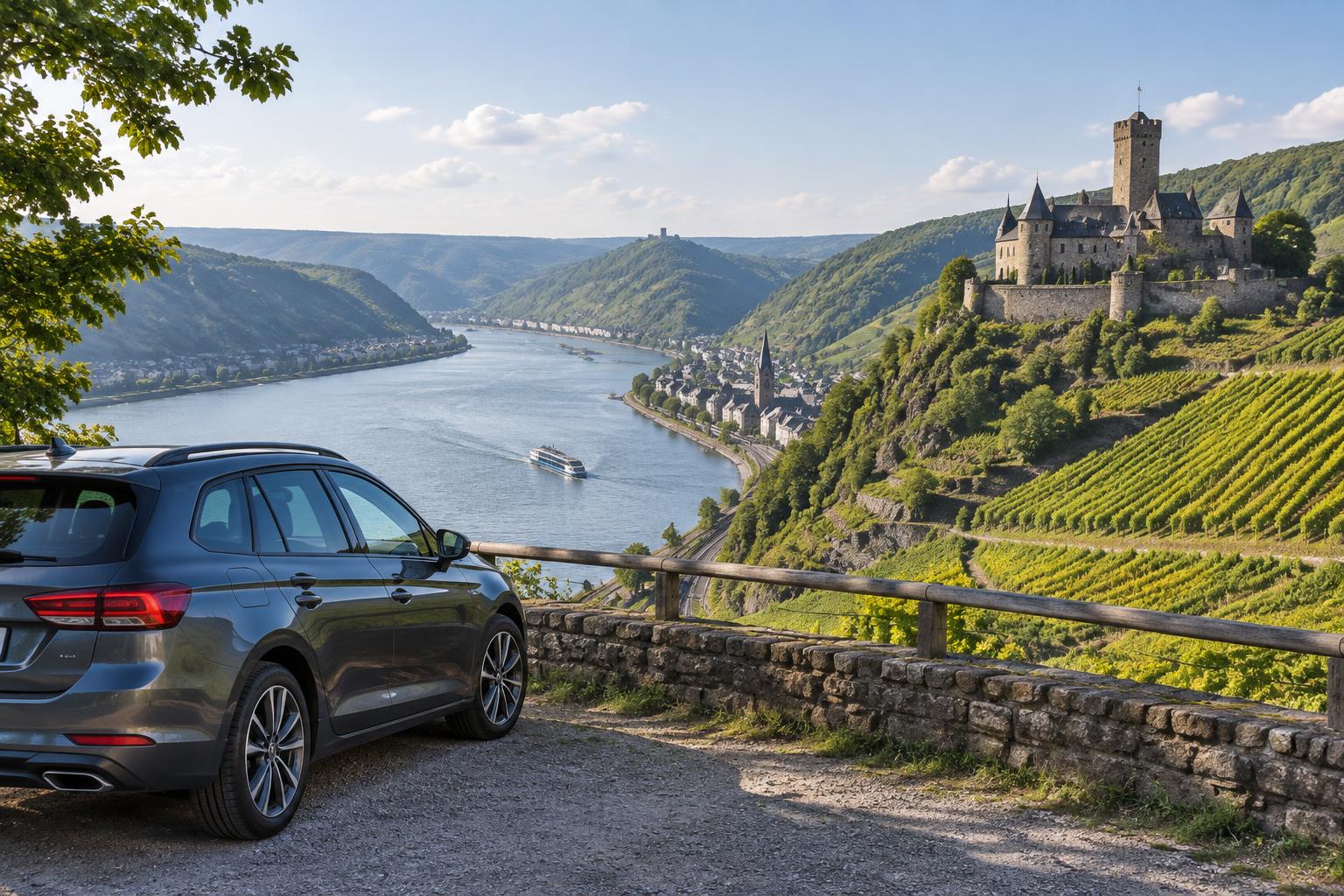
Germany is a country with immense geographical and cultural diversity. It stretches from the Alps in the south to the plains in the north, and from the industrial centres of the west to the historic cities of the east. Car hire in Germany allows you to cover these distances comfortably and safely. For example, the distance from Munich to Berlin is approximately 600 kilometres and can be covered in about 6 hours of driving, passing through beautiful landscapes of Thuringia and Bavaria. If you start from the south, Munich is the perfect base for exploring the Bavarian Alps. You can find useful information on where to stay in Munich to ensure easy access to the city's exits. From there, in less than two hours of driving, you'll find yourself at the famous Neuschwanstein Castle or the crystal-clear Eibsee lake. Driving in this region is enchanting, with roads winding through mountains and forests, offering unforgettable views. In western Germany, the Rhine and Moselle valleys offer routes filled with vineyards and medieval castles. Frankfurt is the main entry point for many travellers. If you choose this city as your starting point, consult a guide on where to stay in Frankfurt to better organise your first few days. From there, distances to cities like Heidelberg or Baden-Baden are short, making day trips very straightforward. In the north, Hamburg and Berlin dominate. Germany's capital is a metropolis that combines history with modern culture. Although traffic within Berlin can be heavy, a car is essential if you want to visit Potsdam or the lakes of Brandenburg. Germany boasts one of the densest motorway networks in the world, meaning even the most remote areas are easily accessible. The right car hire will make your trip much easier and transform your journey into a continuous exploration.Pick-up Locations and Rental Process
The process for car hire in Germany is simple and very well-organised. Most agencies operate to high service standards. The most popular pick-up points are undoubtedly the airports. Frankfurt Airport (FRA) and Munich Airport (MUC) have huge car rental centres directly connected to the terminals. The new Berlin Airport (BER) also offers excellent facilities. Apart from airports, you can pick up your car from the main railway stations (Hauptbahnhof) in every major city. This is particularly convenient if you arrive in Germany by train from a neighbouring country. There are also many branches in central city locations and large hotel complexes. When making your reservation, you will need to have your ID card or passport, driving licence, and a credit card in the main driver's name for the deposit. International companies such as Sixt, Europcar, Hertz, and Avis have a presence everywhere, while smaller companies often offer competitive prices. It's always a good idea to do some market research and read tips for car rental before finalising your choice.Rental Costs and Vehicle Categories
Car hire prices in Germany depend on many factors, such as the type of vehicle, rental duration, and time of year. Generally, Germany offers very good prices compared to other Western European countries, due to strong competition. Below is an indicative table of car categories and average daily costs:| Car Category | Low Season (Daily) | High Season (Daily) |
|---|---|---|
| Mini / Economy (e.g. VW Polo) | 25 € to 35 € | 40 € to 55 € |
| Compact (e.g. VW Golf) | 35 € to 50 € | 55 € to 75 € |
| SUV / Crossover | 45 € to 65 € | 70 € to 100 € |
| Station Wagon (ideal for families) | 40 € to 60 € | 65 € to 90 € |
| Luxury / Premium (e.g. BMW, Mercedes) | 70 € to 120 € | 110 € to 180 € |
Insurance and Deposit
Insurance is one of the most important aspects of car rental. In Germany, basic third-party insurance is mandatory and always included in the price. However, most travellers opt for Collision Damage Waiver (CDW), which limits your liability to a specific amount, known as the excess. This excess amount can range from 500 € to 1500 € depending on the car category. Upon pick-up, the company will block this amount on your credit card as a deposit. If you want complete peace of mind, you can choose full insurance with zero excess (FDW), which usually costs an additional 15 to 25 € per day. It's a good investment, as it protects you from minor damage in car parks or scratches that can occur in the city. Before signing, carefully read the tips before renting a car regarding coverages and hidden charges.Driving Licence and Age Restrictions
For holders of driving licences from EU member states, such as Greece, things are simple. The Greek driving licence (card format) is fully accepted, and no other action is required. However, if your licence is from a country outside the EU, such as the USA or Australia, you will probably also need an International Driving Permit, which accompanies your national licence. Regarding age, most companies in Germany allow rentals to individuals over 21 years old. However, for drivers under 25, an additional daily "young driver" surcharge is often imposed. Also, some luxury vehicle categories may require the driver to be over 25 or even 30 years old, and to have held their driving licence for at least 2 or 3 years.Driving and Parking Rules in Germany
Driving in Germany follows strict rules, and adherence to them is essential to avoid fines. German drivers are generally disciplined and expect the same from you. One of the country's most famous features is the Autobahn, where in many sections, there is no general speed limit. However, there is a "recommended speed" of 130 kilometres per hour. It is extremely important to use the left-hand lane only for overtaking and to return to the right immediately afterwards. Tailgating is considered a serious offence and is strictly penalised. Within cities, the speed limit is usually 50 kilometres per hour, while in many residential areas, it can be 30. Parking can be a challenge in the centres of large cities. Look for "Parkhaus" signs (multi-storey car parks), which are the safest and often the most economical solution for a few hours. Many cities have established "Umweltzonen" (environmental zones), where cars must display a special green sticker on the windscreen indicating their low emissions. Most rental cars already have this, but it's good to confirm upon pick-up. Unlike many neighbouring countries, there are no tolls for passenger cars on motorways in Germany. This makes travel much more economical. However, if you plan to cross the border into Austria or Switzerland, you will need to purchase a special vignette (toll sticker) as soon as you enter these countries.Suggested Routes and Day Trips
With car hire in Germany, countless excursion options open up to you. One of the most famous routes is the Romantische Straße (Romantic Road), which starts from Würzburg and ends in Füssen, in the Alps. Along the way, you will encounter towns like Rothenburg ob der Tauber, which looks like it's straight out of a fairytale. If you are in the south, the route around Lake Constance (Bodensee) is wonderful, as you can visit three different countries (Germany, Austria, Switzerland) in one day. If you land in Munich, it's worth checking out the options for transport from Munich Airport to the city centre to pick up your car and start your adventure. In the north, the route along the Baltic coast, from Lübeck to the island of Rügen, offers a completely different picture of Germany, with sandy beaches and historic seaside resorts. For those arriving in Berlin, the journey to Dresden is short and offers the opportunity to see one of Europe's most beautifully reconstructed cities. Don't forget to get information about transport from Berlin Airport to the city centre if you plan to pick up your vehicle from there.Tips for Economical Car Hire
To keep costs down, there are a few secrets you should know. Firstly, avoid renting a car for days when you will be exclusively in a large city like Berlin or Munich. Parking is expensive, and public transport is excellent. Only rent the vehicle for your excursion days. Secondly, pay attention to the fuel policy. The best option is "full to full". You pick up the car with a full tank and return it full. Try to refuel at petrol stations away from the motorway or airport, as prices there are often 10 to 20 cents more expensive per litre. Thirdly, if you are travelling with children, consider bringing your own car seat if possible, as companies charge quite a lot per day for its rental. Finally, always check the vehicle for existing damage upon pick-up and take photos or videos, to avoid any disputes upon return. Car hire in Germany is the best way to experience the country like a local, discover small tavernas in the countryside, and see landscapes that most tourists miss. With proper organisation and adherence to the rules, your road trip in Germany will be one of the most enjoyable experiences of your life.Frequently Asked Questions
Do I need an International Driving Permit for Germany?
If you hold a new-style Greek driving licence (card), you do not need an international permit. The Greek licence is normally recognised in all European Union countries. If your licence was issued outside the EU, then an international permit is mandatory.
What is the average cost for car hire in Germany?
The average cost for an economy car ranges from 30 € to 50 € per day. Prices are affected by the season, the type of vehicle, and how far in advance you book. Prices are usually higher during the summer months and the Christmas period.
Are there tolls on German motorways?
No, for passenger cars, the use of motorways (Autobahn) in Germany is free. Only lorries pay tolls. However, if you plan to cross into neighbouring countries such as Austria, Switzerland, or the Czech Republic, you will need to purchase the corresponding vignette.
Can I rent a car without a credit card?
Most major rental companies require a credit card in the driver's name for the security deposit. Some companies may accept a debit card, but this usually comes with the obligation to purchase the company's full insurance, which increases the cost.
What are environmental zones (Umweltzonen)?
Many German cities have designated areas in their centres where only low-emission vehicles are allowed to enter. These vehicles must display a green sticker on the windscreen. Most rental cars are new and already have this sticker.
What is the speed limit in Germany?
In cities, the limit is 50 km/h and on rural roads 100 km/h. On the Autobahn, there is a recommended speed of 130 km/h, although in many sections there is no upper limit. However, you should always pay attention to the signs, as there are many sections with local restrictions due to roadworks or traffic.
Is it safe to drive in Germany in winter?
Yes, it is perfectly safe as roads are cleared of snow immediately. However, the law requires the use of winter tyres when icy or snowy conditions prevail. Rental cars during the winter season are obligatorily equipped with the appropriate tyres, often with a small additional charge.

Η συντακτική ομάδα
Travelo Team
Συντακτική ομάδα του Travelo.gr
Πολυταξιδεμένη συντακτική ομάδα με πάνω από 15 χρόνια στον ταξιδιωτικό δημοσιογραφικό χώρο και περισσότερους από 45 προορισμούς σε Ελλάδα και Ευρώπη. Έχουμε διανυκτερεύσει σε εκατοντάδες καταλύματα — από μικρά οικογενειακά ξενοδοχεία και παραδοσιακούς ξενώνες μέχρι resorts 5 αστέρων — και δοκιμάζουμε προσωπικά περιοχές, μεταφορές και υπηρεσίες πριν προτείνει κάτι.
- 45+ προορισμοί επί τόπου
- 500+ καταλύματα σε αξιολόγηση
- 15 χρόνια ταξιδιωτικής αρθρογραφίας
Πώς δουλεύουμε: κάθε οδηγός βασίζεται σε επιτόπια εμπειρία, διασταύρωση αξιολογήσεων επισκεπτών και έλεγχο διαθεσιμότητας/τοποθεσίας κάθε καταλύματος. Ορισμένοι σύνδεσμοι είναι συνεργατικοί (affiliate) — αν κάνετε κράτηση μέσω αυτών, στηρίζετε το Travelo.gr χωρίς καμία επιπλέον χρέωση για εσάς, και δεν επηρεάζουν τις προτάσεις μας. Τελευταία ενημέρωση οδηγού: 26 Σεπτεμβρίου 2026.