Dubai for digital nomads: visa, cost of living, neighbourhoods and company setup
How to live and work remotely from Dubai: visa for remote workers, monthly cost, best neighbourhoods, coworking and when it’s worth setting up a company in a free zone.
Από Travelo Team
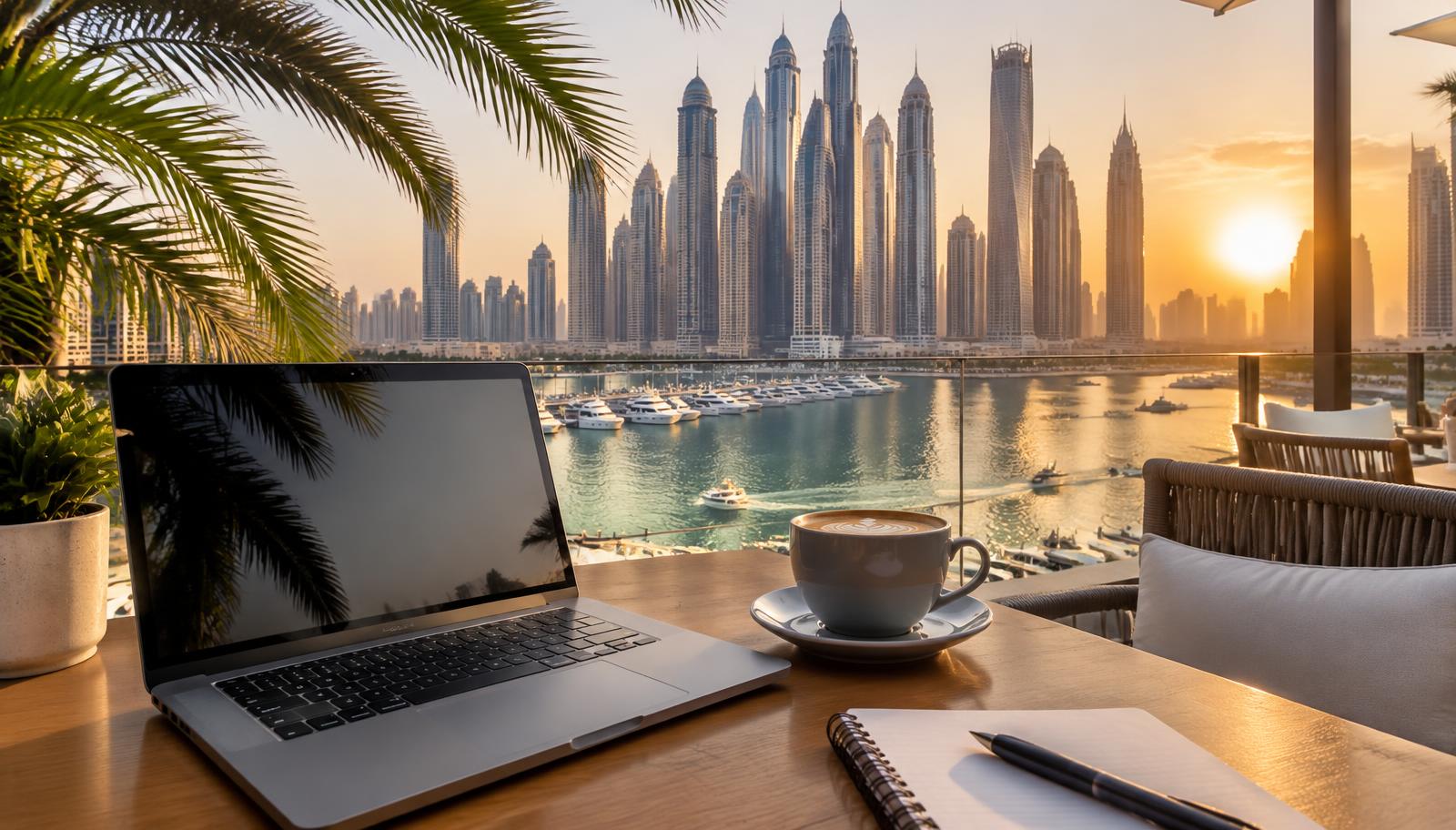
Dubai has become one of the top choices for those who work with a laptop and desire sunshine, safety, fast internet, and direct flights worldwide. The short answer: yes, you can legally live and work there, either as an employed remote worker with the special UAE visa, or as a freelancer with your own company in a free zone. In this guide, you’ll find information on the visa, how much a month costs, which neighbourhoods are worth staying in, and when it makes sense to set up a company.
If you're looking for an overview of life as a digital nomad, start with the guide to digital nomads, travel and company structure. Here, we focus solely on Dubai.
Why Dubai attracts digital nomads
Dubai isn't cheap, but it offers a combination that's hard to find elsewhere. There is no income tax for individuals, the city is one of the safest in the world, and the infrastructure works without surprises. English is widely spoken, banking and services are largely digitised, and DXB airport connects the city with over 250 destinations.
There's also the time zone factor. Dubai is one hour ahead of Greece in summer and two hours in winter. If you have clients in Europe, you work almost the same hours. If you have clients in Asia, you also catch their mornings. Since 2022, the weekend is Saturday and Sunday, like in Europe, which greatly helps communication with collaborators.
The downsides are well-known. In summer, from June to September, temperatures easily reach 42 to 45 degrees Celsius, and life moves indoors to air-conditioned spaces. Rents are high and increase every year. Calls via WhatsApp and FaceTime don't always work on the local network, so for video calls, you'll use Teams, Zoom or Google Meet, which work normally. For an initial introduction to the city, see the ultimate travel guide to Dubai.
Visa and residence permit for remote workers
Greek citizens enter the UAE visa-free and can stay up to 90 days within a 180-day period. This is sufficient for a trial stay or for a winter. If you wish to stay longer, rent a home with your own contract, or open a local bank account, you will need a residence permit.
The Virtual Working Programme visa
The UAE has a special programme for those who work remotely for an employer or clients outside the country. The visa is valid for one year, is renewable, and provides an Emirates ID, which is the basic identification required for almost everything in the country. The main requirements are:
- Passport valid for at least six months.
- Proof of employment with an overseas company or ownership of a company outside the UAE.
- Minimum monthly income of 3,500 USD, with bank statements from the past few months.
- Health insurance with coverage within the UAE.
The total cost, including fees, medical exams, and Emirates ID, usually ranges from 1,500 to 2,500 AED, which is approximately 370 to 620 euros. These amounts change periodically, so always check official government portals before applying.
The alternative: visa through your own company
If you are a freelancer without a fixed employer or want to invoice from the UAE, the most common solution is to open a company in a free zone. The company's licence grants you the right to an investor visa, and sometimes visas for partners or family. More on this in the section about company setup.
How much a month costs in Dubai
The cost primarily depends on accommodation. Those who come for a few weeks usually stay in a serviced apartment or a hotel with a monthly rate, while those staying over six months rent with an annual contract, which works out significantly cheaper. For holidays before or after settling in, the guide how much a trip to Dubai costs provides a good overview of food, attractions, and transport.
Indicative monthly budget for one person:
- Studio in JVC or Al Barsha: 4,500 to 6,500 AED.
- Studio or one-bedroom apartment in Marina or Business Bay: 7,000 to 11,000 AED.
- Utility bills (electricity, water, internet): 500 to 900 AED, more in summer months due to air conditioning.
- Coworking with a hot desk: 800 to 1,500 AED.
- Food, combining cooking and dining out: 2,000 to 3,500 AED.
- Transport by metro, taxi, and apps: 500 to 1,000 AED.
- Mobile with data plan: 150 to 300 AED.
In total, a reasonable month ranges from 9,000 to 15,000 AED, which is approximately 2,200 to 3,700 euros. It's more expensive than Lisbon or Bali, but for those with a high income, the absence of income tax often covers the difference.
Where to stay as a digital nomad
Choosing a neighbourhood is the most important decision, as Dubai spans a large area and travel distances in traffic matter. It's good to stay near a metro station or close to the coworking space you'll be using. For hotels and a detailed description of each area, read the guide where to stay in Dubai.
Dubai Marina and JLT
The most popular area for young professionals. It has a beach, a waterfront promenade, many cafes with good Wi-Fi, and two metro and tram stations. Jumeirah Lake Towers, directly opposite, is slightly cheaper and has its own free zone, DMCC, with many small companies and coworking spaces.
Downtown and Business Bay
Next to the Burj Khalifa and Dubai Mall. Business Bay is full of offices, skyscrapers with apartments, and coworking spaces, ideal if you have frequent meetings. It's expensive, but has the best connection to DIFC, the city's financial centre.
Jumeirah Village Circle (JVC)
The most affordable option for a long stay, with newly built buildings, swimming pools, and parks. The disadvantage is that it doesn't have a metro, so you'll need a car or taxi. It suits those who primarily work from home.
Al Barsha, Deira and Bur Dubai
Al Barsha is practical, close to the Mall of the Emirates and the metro. Deira and Bur Dubai are the old city, with souks, authentic food, and lower rents, but with more noise and fewer foreign professionals. For the more traditional side of the city, also take a look at the article Dubai: what you need to know.
| Area | Studio Rent (AED/month) | Metro | Ideal for |
|---|---|---|---|
| Dubai Marina | 7,000 to 10,000 | Yes | Social life, beach |
| JLT | 5,500 to 8,000 | Yes | Company in DMCC |
| Business Bay | 7,500 to 11,000 | Yes | Meetings, city centre |
| JVC | 4,500 to 6,500 | No | Long-term stay, budget |
| Al Barsha | 5,000 to 7,000 | Yes | Practical daily life |
Coworking, internet and daily work
Internet in Dubai is fast and stable. Fibre optic home connections usually exceed 500 Mbps, and most cafes, hotels, and shopping centres have free Wi-Fi. The two mobile providers are Etisalat (e&) and du, and with a passport, you can get a tourist-type SIM card within minutes at the airport.
Coworking spaces exist in every business district. Some operate within free zones, such as DMCC or Dubai Internet City, and you can often use their address for your company's licence. Day passes usually cost 75 to 150 AED, which is convenient if you want to try it out before committing for a month.
A few practical tips to make life easier:
- The Nol card covers metro, tram, and buses. It can be topped up at any station.
- Careem and Uber apps are the easiest way to get a taxi.
- During Ramadan, office hours are shorter, and you don't eat or drink publicly during the day.
- Always keep a copy of your passport and, once acquired, your Emirates ID with you.
Taxation and company: what a digital nomad needs to know
This is the section that interests most people, and it's worth reading carefully. The UAE does not impose income tax on individuals. As of June 2023, a corporate tax of 9% applies to profits over 375,000 AED, while companies in free zones that meet specific criteria can have a 0% rate on income classified as qualifying. There is also 5% VAT for businesses with turnover above a certain threshold.
The crucial point is tax residency. A residence visa alone does not make you a tax resident of the UAE, nor does it automatically exempt you from your previous country's tax obligations. The UAE issues a tax residency certificate to those who stay there for at least 183 days a year, or 90 days under certain conditions. Your country of origin has its own rules, and specialised advice is needed there before making any decisions.
Free zone or mainland
For most digital nomads, a free zone is the natural choice. It allows 100% foreign ownership, the process is almost entirely online, and the cost for a simple licence with one visa starts from approximately 12,000 to 20,000 AED per year, depending on the zone. A mainland company is only necessary if you want to sell directly to the local market or undertake public works.
If you want to see the step-by-step process, there are specialised services for free zone company setup Dubai, which handle licences, visas, and bank accounts. Since prices vary greatly between zones, it's worth comparing which is the cheapest free zone in UAE for your activity before deciding.
For Greek-language guidance, with an emphasis on what it means for someone leaving Greece, see the detailed guide for company formation in Dubai.
Alternative structures for those who travel constantly
Dubai suits those who want a stable base and genuine residency. However, if you change countries every few months and don't plan to stay half the year in the UAE, a company there might not be the best solution. Many nomads choose a Wyoming LLC for digital nomads, which has low costs and doesn't require physical presence in the USA. Others prefer European countries like Cyprus or Estonia. A comprehensive comparison of options can be found in the guide for company formation abroad.
Practical information for Dubai
- Flights: There are direct flights from Athens with Emirates and flydubai, lasting approximately 4 hours and 30 minutes.
- Best time to visit: From November to March, with temperatures between 20 and 30 degrees Celsius.
- Currency: Dirham (AED). One euro is approximately equivalent to 4 AED.
- Healthcare: Private hospitals are very good but expensive. Health insurance is essential.
- Banks: For a local account, you usually need an Emirates ID. Until then, European digital banks work without issue.
- Rules: Alcohol is only permitted in licensed establishments. Respect the dress code in mosques and government buildings.
If you're thinking of spending a year changing bases, Dubai combines well with a European stop in the summer, such as Lisbon, and an Asian one, like Bali, which remains one of nomads' favourite choices.
Frequently Asked Questions
Do I need a visa to work remotely from Dubai for a few weeks?
As a Greek citizen, you can enter visa-free for up to 90 days. For a longer stay, for a rental agreement or for a local bank account, you need a residence permit, such as the Virtual Working Programme visa or a visa through a company.
What is the minimum income for the remote work visa?
A minimum monthly income of 3,500 US dollars is required, with proof from your employer or bank statements. Criteria may change, so check them before applying.
If I live in Dubai, do I pay income tax?
The UAE does not tax personal income. However, this does not mean that you automatically cease to have tax obligations in the country you left. You need to officially change your tax residency, with the help of an advisor.
How much does it cost to set up a company in a free zone?
For a simple licence with one visa, the annual cost starts from approximately 12,000 AED and can reach 20,000 AED or more, depending on the zone, activity, and office space.
Which is the best area for digital nomads?
Dubai Marina and JLT are the most popular choices for social life, coworking, and metro access. If you want lower rent and primarily work from home, JVC is a good option.
Do WhatsApp calls work in Dubai?
Messages work normally, but WhatsApp and FaceTime voice and video calls often do not connect. Tools like Zoom, Teams, and Google Meet work without issue.
Is Dubai a good year-round base?
From October to April, it's excellent. In summer, the heat is intense, which is why many nomads spend these months in Europe and return in autumn.

Η συντακτική ομάδα
Travelo Team
Συντακτική ομάδα του Travelo.gr
Πολυταξιδεμένη συντακτική ομάδα με πάνω από 15 χρόνια στον ταξιδιωτικό δημοσιογραφικό χώρο και περισσότερους από 45 προορισμούς σε Ελλάδα και Ευρώπη. Έχουμε διανυκτερεύσει σε εκατοντάδες καταλύματα — από μικρά οικογενειακά ξενοδοχεία και παραδοσιακούς ξενώνες μέχρι resorts 5 αστέρων — και δοκιμάζουμε προσωπικά περιοχές, μεταφορές και υπηρεσίες πριν προτείνει κάτι.
- 45+ προορισμοί επί τόπου
- 500+ καταλύματα σε αξιολόγηση
- 15 χρόνια ταξιδιωτικής αρθρογραφίας
Πώς δουλεύουμε: κάθε οδηγός βασίζεται σε επιτόπια εμπειρία, διασταύρωση αξιολογήσεων επισκεπτών και έλεγχο διαθεσιμότητας/τοποθεσίας κάθε καταλύματος. Ορισμένοι σύνδεσμοι είναι συνεργατικοί (affiliate) — αν κάνετε κράτηση μέσω αυτών, στηρίζετε το Travelo.gr χωρίς καμία επιπλέον χρέωση για εσάς, και δεν επηρεάζουν τις προτάσεις μας. Τελευταία ενημέρωση οδηγού: 28 Σεπτεμβρίου 2026.